
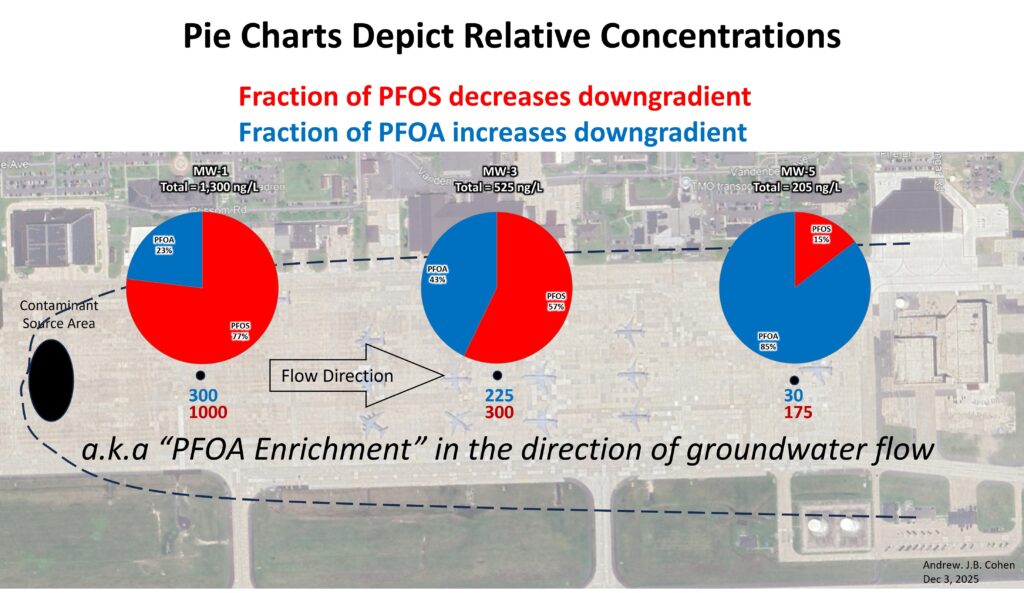
This video explains why PFAS “chemical signatures” measured in groundwater can differ from place to place even when there is only a single contaminant source. The concept of PFAS fractionation (also referred to as PFAS enrichment) is a fundamental fate-and-transport process driven by differential sorption to organic carbon in aquifer materials. This microscale and macroscale process is illustrated graphically.
Because individual PFAS compounds have distinct chemical properties, they sorb at different rates and strengths as groundwater flows, selectively retaining some compounds while allowing others to migrate farther. The result is a spatially evolving PFAS mixture that can look like multiple sources when, in fact, it reflects a single source modified by subsurface processes. Understanding this mechanism is critical for correctly interpreting groundwater data, avoiding false source attribution, and making defensible technical and regulatory decisions.
For purposes of clarity, this explanation considers a simple PFOA/PFOS mixture. In reality, mixtures contain many more PFAS chemicals, but the concept still holds.